
Volatility doesn’t usually ruin retirements. Bad timing does.
The real risk is being forced to make income decisions at the wrong time.
Key Insight
Retirement plans usually fail because income structure collides with bad timing — not because long-term returns were insufficient.
The Problem Most People Miss
The 4% rule, introduced by William Bengen in 1994, showed that a diversified portfolio historically sustained 4% withdrawals for 30 years in most scenarios.
On paper, that’s reassuring. But retirement doesn’t happen “on paper.” It happens in sequence.
Wade Pfau and others have shown that early negative returns — especially in the first 5–10 years — materially increase failure rates.
Two retirees can experience the same 30-year average return, but one runs out of money, and one doesn’t. The difference is the order of returns combined with withdrawal demands. That’s sequence risk.
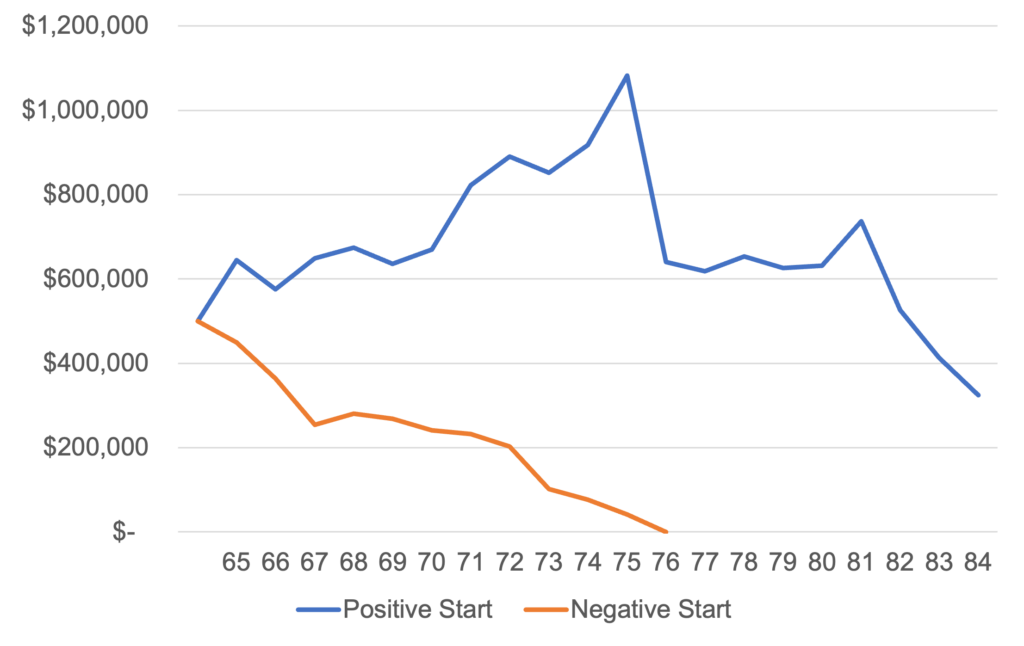
Volatility Isn’t the Killer. Forced Selling Is.
Markets recover. Assets sold during downturns doesn’t.
If income requires selling depressed assets:
- The portfolio base shrinks
- Future compounding capacity weakens
- The margin for error narrows
Guyton & Klinger (2006) demonstrated that flexible withdrawal rules improve sustainability compared to fixed withdrawals. Morningstar’s recent research confirms that safe withdrawal rates shift depending on forward returns and flexibility.
Structure matters more than averages.
Behavior Magnifies Structural Weakness
DALBAR’s long-running data shows that investors consistently underperform markets due to poorly timed decisions.
Vanguard’s Advisor Alpha research identifies behavioral discipline and withdrawal planning as major contributors to long-term outcomes.
Volatility exposes weak structure. Weak structure invites bad decisions.
Longevity Raises the Stakes
Retirement now often spans 25–35 years. Society of Actuaries surveys show many retirees underestimate lifespan.
The longer the horizon, the more likely a weak early sequence becomes damaging. If a plan only works when markets cooperate, it leaves little room for error.
The More Useful Question
Most people ask: “Will my portfolio average 6–7%?”
A better question is: “If markets decline early in retirement, does my income plan continue without forced asset sales?”
That’s an income architecture question. Not a return projection question.
What Strong Design Looks Like
Accumulation logic assumes growth plus steady withdrawals.
Retirement design requires something different:
- Essential expenses insulated from market timing
- Flexibility in discretionary spending
- Income sources that behave differently under stress
Layered income structures reduce the range of bad outcomes. They don’t eliminate volatility. They reduce the consequences of bad timing.
At InnoSight, we approach retirement as a research-driven income design problem — not simply an asset allocation exercise. The objective is to reduce structural fragility under stress.
Retirement risk is less about market movement and more about whether your income structure forces decisions during it.
A calm way forward
The 4% rule isn’t wrong. It’s incomplete.
Volatility is normal. Sequence risk is inevitable. Structural vulnerability is optional. Retirement is not primarily about maximizing returns. It’s about designing income that behaves consistently when markets don’t.
If you’d like to evaluate how your income structure behaves under different market sequences, I’m happy to walk through it with you.
Key Takeaways
1. Sequence risk, not volatility alone, drives many retirement failures.
2. Forced withdrawals during downturns permanently reduce recovery capacity.
3. Withdrawal flexibility materially improves sustainability.
4. Income layering reduces exposure to weak early sequences.
5. Retirement planning is primarily an income design problem.
References & Further Reading
- William Bengen — Determining Withdrawal Rates Using Historical Data (1994)
- Wade Pfau — Sequence Risk & Safe Withdrawal Research
- Guyton & Klinger — Decision Rules and Maximum Initial Withdrawal Rates (2006)
- Morningstar — Safe Withdrawal Rate Updates (2022–2024)
- DALBAR — Quantitative Analysis of Investor Behavior
- Vanguard — Advisor Alpha
- Society of Actuaries — Longevity Risk Surveys
